You step in, turn the tap, and all you get is scalding hot water with no cold to balance it out. It’s frustrating — and honestly a bit alarming. But before you pick up the phone and call a plumber, there’s a very good chance you can fix this yourself in under 10 minutes with no tools at all.
First — Is It Just Your Shower, or the Whole House?
Before touching anything, do a quick check. Turn on a cold tap anywhere else in your home — the kitchen sink, bathroom basin, outside tap. Is the cold water working there?
If cold water is fine everywhere else: The problem is isolated to your shower. Keep reading — this guide covers exactly that.
If there’s no cold water anywhere in the house: You likely have a mains supply issue, a closed stopcock, or a burst pipe. Skip to the section at the bottom on when to call a plumber.
The Most Likely Culprit: Your Thermostatic Cartridge
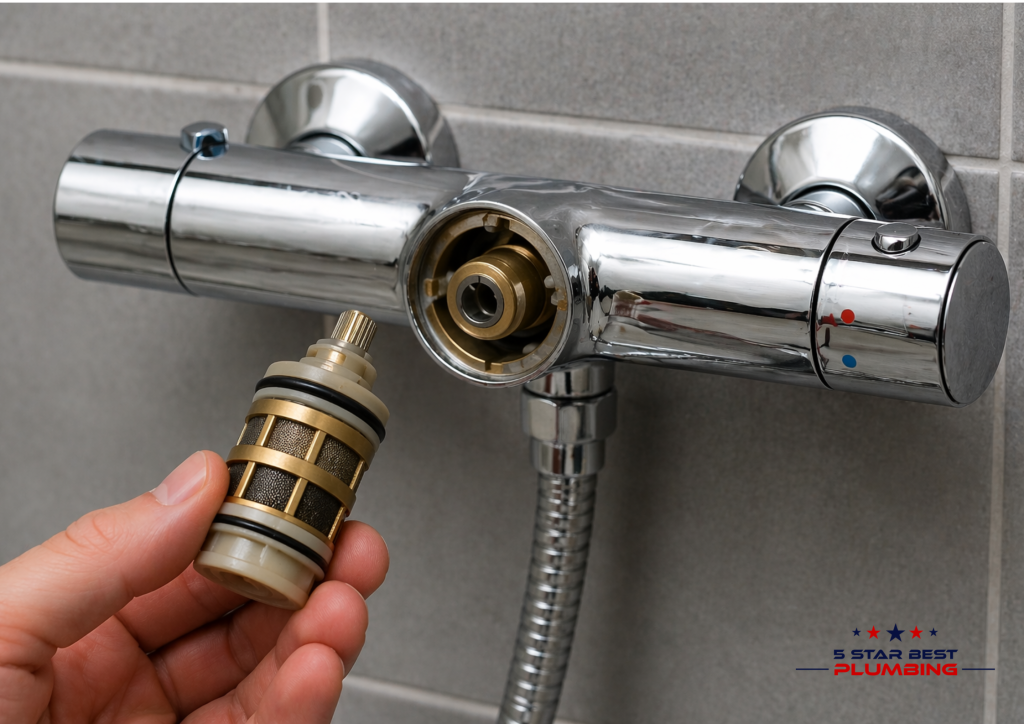
Here’s what most people don’t know. Modern showers — especially mixer showers and thermostatic bar valves — contain a small component called a thermostatic cartridge. Its entire job is to blend hot and cold water to your chosen temperature.
When this cartridge fails, wears out, or gets stuck, it often fails in the same direction: full hot, no cold. This is by design — it’s a safety feature called a “fail-safe” position. The cartridge defaults to hot rather than cold to prevent scalding in reverse (a cold-only shower in winter can be a shock hazard for vulnerable users). The U.S. Consumer Product Safety Commission notes that water above 130°F can cause a serious scald in 30 seconds or less, which is exactly why this fail-safe exists.
The good news? This is the most common cause — and one of the easiest to fix.
The Simple Fix: Check and Reset Your Pressure Balancing Valve
Before replacing anything, try this first. Many thermostatic shower valves have a small anti-scald limiter or pressure balancing cap that can be manually adjusted or reset. Over time — especially after plumbing work nearby, a water pressure fluctuation, or even just age — this limiter shifts out of position.
What you need: A flathead screwdriver. That’s it.
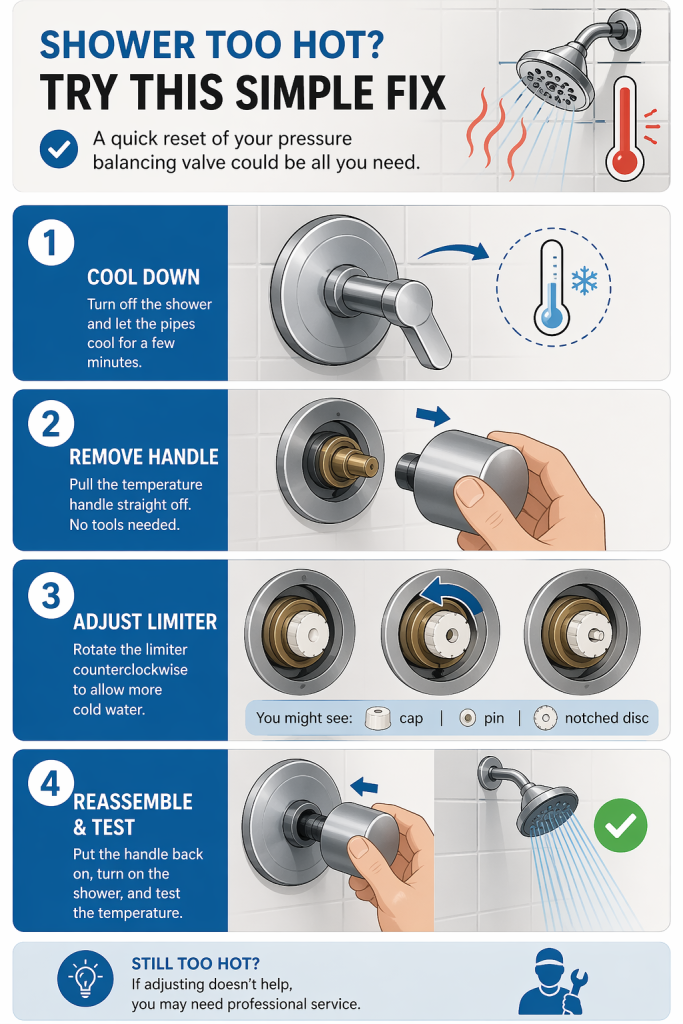
Step 1: Turn off your shower and let the pipes cool for a few minutes.
Step 2: Locate the temperature control handle on your shower valve. On most models, the handle pulls straight off — no screwdriver needed. Give it a firm pull outward.
Step 3: Behind the handle you’ll see either a plastic cap, a small pin, or a notched disc. This is your temperature limiter. On most valves it can be rotated — turn it counterclockwise to allow more cold water through.
Step 4: Reattach the handle, turn the shower on, and test. Many homeowners find this alone solves the problem completely.
If That Doesn't Work: Check the Cold Water Isolation Valve
Your shower has its own dedicated cold water supply line feeding into the valve. That line has an isolation valve — a small inline tap that can accidentally be turned off, partially closed, or closed during other plumbing work and forgotten about.
Where to find it: Look under the bath panel, inside an access hatch behind the shower wall, or under the floor if you have an exposed pipe run. It’s usually a small slotted screw or a quarter-turn lever on the cold water pipe running to the shower.
What to check: The slot or lever should be running parallel to the pipe — that means open. If it’s perpendicular to the pipe, it’s closed. Turn it a quarter turn so it’s parallel and test the shower again.
This is more common than you’d think, especially in homes that have recently had any plumbing work done — it’s easy to close an isolation valve to work on something nearby and not fully reopen it afterward.
Still No Cold Water? The Cartridge Needs Replacing
If adjusting the limiter and checking the isolation valve haven’t solved it, the thermostatic cartridge itself has likely failed and needs replacing.
What’s involved: The old cartridge pulls or unscrews out of the valve body, and a new one drops in. Most are secured by a single retaining clip or nut. The whole job takes 20–30 minutes for a confident DIYer, or about the same for a plumber — it’s a quick visit.
What you need to know before buying a replacement: Cartridges are brand and model specific. Check the valve body or your original paperwork for the manufacturer name and model number — Grohe, Hansgrohe, Mira, Triton, Aqualisa, and Bristan all use different cartridges. A generic replacement usually won’t fit.
DIY or call a pro? If you’re comfortable turning off the water supply and doing basic disassembly, this is a manageable DIY job. If there’s any uncertainty, a plumber will have it done in under an hour.
Could It Be Anything Else?
In rare cases, the cause isn’t the cartridge or the isolation valve. Other possibilities include a failed diverter valve (if your shower shares a bath/shower mixer), a blockage in the cold supply line, or in older properties, a failed gate valve on the cold tank supply. These are less common and harder to diagnose without a professional assessment.
When to Call a Plumber
Call a plumber if:
- There’s no cold water anywhere in your home, not just the shower
- You’ve checked the isolation valve and it’s fully open
- You’ve reset the temperature limiter and it hasn’t helped
- The cartridge is the issue but you’re not comfortable replacing it yourself
- Your shower valve is more than 10–15 years old and may need a full replacement rather than a cartridge swap
Got No Cold Water in Your Shower? We'll Have It Fixed Today.
Now you know what’s likely causing it — but if the quick fixes haven’t worked, or you’d simply rather have a professional handle it, we’re ready to help.
Our plumbers carry the most common shower cartridges on the van, which means most shower repairs are sorted in a single visit without waiting for parts. Related reading: 5 Warning Signs Your Shower Cartridge Is Going Bad.
When you book with us:
- Same-day and next-day appointments available
- Upfront fixed pricing — you’ll know the cost before we start
- All parts and labor guaranteed for 12 months
- Friendly, tidy plumbers who respect your home
Don’t put up with a shower that’s too hot to use. Contact us today.
FAQs
Why does my shower only run hot and not cold?
In most cases it’s a failed or stuck thermostatic cartridge inside the shower valve. The cartridge defaults to the hot position when it fails — it’s a built-in safety mechanism. Checking the temperature limiter and cold water isolation valve first costs nothing and fixes the problem surprisingly often.
Can I fix a shower with no cold water myself?
The two simplest checks — resetting the temperature limiter and opening the cold isolation valve — require no plumbing knowledge and take minutes. Replacing the cartridge is a manageable DIY job for most people, but requires turning off the water supply and sourcing the correct model-specific cartridge.
How do I know if my shower cartridge needs replacing?
If adjusting the temperature limiter makes no difference, cold water is confirmed flowing on other taps, and the isolation valve is fully open, the cartridge is almost certainly the cause. A plumber can confirm this in minutes.
How long does a shower cartridge last?
Most thermostatic cartridges last 8–15 years under normal use. Hard water areas significantly shorten this lifespan as limescale builds up inside the cartridge. If you’re in a hard water area, a filter on the supply line can extend cartridge life considerably.
Why is there no cold water in my shower but my sinks are fine?
When only the shower loses cold water but sinks and other fixtures are fine, the problem is almost always inside the shower valve itself — typically the thermostatic or pressure-balance cartridge failing or getting stuck in the hot position. Since the cold water supply to the rest of the house is unaffected, you can rule out a whole-house supply issue and focus on the shower valve. A plumber can usually confirm and fix this with a cartridge replacement.