
You flush. You wait. And then you wait some more.
A toilet that takes forever to refill is frustrating — and it’s more common than you’d think. Most toilets should fill up within one to three minutes. If yours is dragging past that, something inside the tank isn’t working the way it should.
The good news? A slow-filling toilet almost always comes down to one of three causes. In this guide, The 5 Star Plumbing team walks you through each one, what to look for, and what to do about it.
What Causes a Toilet to Fill Slowly?
Before reaching for your phone to call a plumber, it helps to understand how your toilet actually works.
Every time you flush, the tank empties and a fill valve opens to let fresh water back in. A float — either a ball or a cup — rises with the water level and signals the fill valve to shut off once the tank is full. The water enters through a supply line connected to a shut-off valve behind the toilet.
When any one of these parts fails, gets clogged, or falls out of position, your toilet starts filling slowly. Here are the three most likely reasons why.
Reason 1: The Fill Valve Is Worn or Clogged
The fill valve is the part doing the heavy lifting every time your toilet refills. It opens after a flush and controls the flow of water into the tank. When it’s working well, you barely notice it. When it starts to fail, your toilet fills slowly — sometimes to the point of taking five minutes or more.
Fill valves wear out over time. The internal seals and diaphragm degrade with use, and mineral deposits from hard water can build up inside the valve and restrict the flow of water. A dirty or damaged fill valve may only open partway, which means water trickles in instead of flowing in freely.
Signs the fill valve is the problem:
- You hear a faint hissing from the tank even after it’s full
- The water level in the tank looks lower than normal
- The toilet runs on and off throughout the day
- Refilling takes noticeably longer than it used to
What to do:
Start by removing the tank lid and watching what happens after a flush. If the water comes in slowly as a trickle rather than a steady stream, the fill valve is likely the issue.
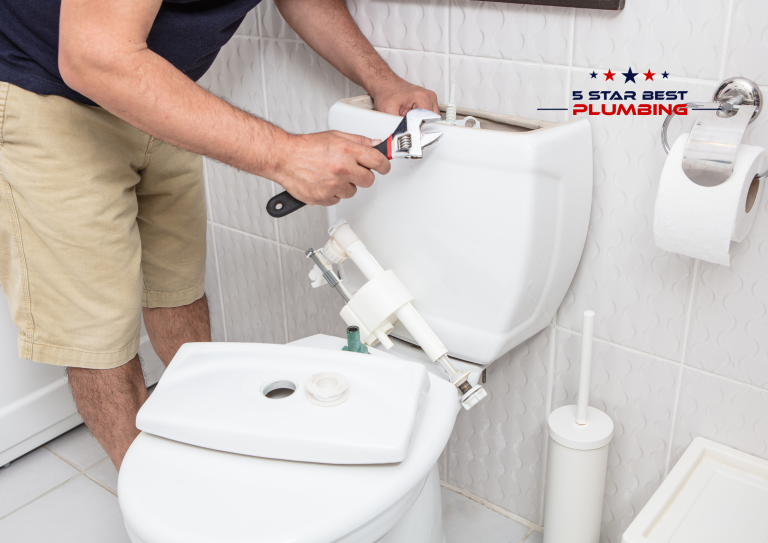
You can try cleaning the valve first. Turn off the water supply, remove the fill valve cap, briefly turn the water back on to flush out any debris, then reassemble. If cleaning doesn’t help — or if the valve looks cracked or heavily scaled — replacement is the right move.
A new fill valve costs $10 to $20 at any hardware store and takes about 30 minutes to install. If you’d rather leave it to a professional, The 5 Star Plumbing can handle it quickly at an affordable price.

Reason 2: The Float Ball Is Waterlogged
If your toilet is an older model, it likely has a float ball — a hollow rubber or plastic ball attached to a metal arm that sits on top of the water in the tank. Its job is to rise with the water level and shut off the fill valve once the tank is full.
The problem is that float balls can crack over time and fill with water. Once that happens, the ball sits lower in the tank than it should. The fill valve reads the ball’s position and thinks the tank is full before it actually is, cutting off water flow too early. The result is a tank that never fully fills, which means weaker flushes and the need to flush multiple times.
A waterlogged float ball can also put extra strain on the float arm, eventually bending it downward and making the problem worse.
Signs the float ball is the problem:
- Your toilet never flushes with full force
- The water level looks low when you remove the tank lid
- The float ball doesn’t sit high on the surface of the water
- You can hear water sloshing inside the ball when you shake it
What to do:
Remove the tank lid and check the float ball. If it’s sitting low or partially submerged, try gently bending the float arm upward. This raises the shutoff point and lets more water into the tank before the valve closes.
If the ball is waterlogged, pull it off the float arm and replace it. Float balls are inexpensive and easy to swap out without tools.
That said, float balls are considered outdated technology. Many plumbers — including our team at The 5 Star Plumbing — will recommend upgrading to a modern fill valve assembly, which is more reliable, more water-efficient, and less likely to cause problems down the road.

Reason 3: The Water Supply Valve Is Partially Closed
The water supply valve is the small knob or lever behind your toilet, near the floor, where the water line comes out of the wall. It controls how much water enters the toilet at all. When it’s fully open, water flows in at full pressure. When it’s even slightly closed, it restricts that flow — and your toilet fills slowly as a result.
This one is easy to overlook because the valve often gets partially closed accidentally. It might have been turned during a repair and never fully reopened. It might have stiffened with age and crept partially closed on its own. Or debris and mineral buildup inside the valve or supply line could be narrowing the passage without you ever touching it.
Low water pressure elsewhere in your home can also slow down toilet filling, and the supply valve is often the first place to check before investigating your home’s main pressure.
Signs the supply valve is the problem:
- The slow filling started after recent plumbing work nearby
- The valve handle looks angled rather than fully parallel to the pipe
- Other fixtures in the bathroom also seem to have weak water pressure
- The valve looks old, corroded, or has visible mineral buildup around it
What to do:
Locate the supply valve behind your toilet and turn it counterclockwise until it stops. That’s the fully open position. Flush the toilet and see if the fill speed improves.
If the valve is fully open and the problem persists, or if the valve feels stiff, won’t turn properly, or shows any signs of leaking, it needs to be replaced. This is a quick and inexpensive repair for a licensed plumber — and ignoring a failing shut-off valve can lead to bigger problems later, including leaks and water damage.

How to Fix a Slow-Filling Toilet: Quick Reference
Not sure where to start? Work through this checklist in order:
- Check the supply valve — make sure it’s fully open (turned counterclockwise all the way)
- Inspect the fill valve — look for misalignment, wear, or mineral buildup and clean or replace as needed
- Check the float ball — replace it if waterlogged, or upgrade to a modern fill valve assembly
- Test your water pressure — if other fixtures are also weak, the issue may be with your home’s supply rather than the toilet itself
- Call a plumber — if none of the above solves it, a licensed professional can diagnose what’s really going on
When to Call The 5 Star Plumbing
Some toilet issues are easy DIY fixes. Others point to something more serious hiding in your plumbing system. Call us if:
- You’ve tried the steps above and your toilet is still filling slowly
- The supply valve is corroded, stiff, or leaking
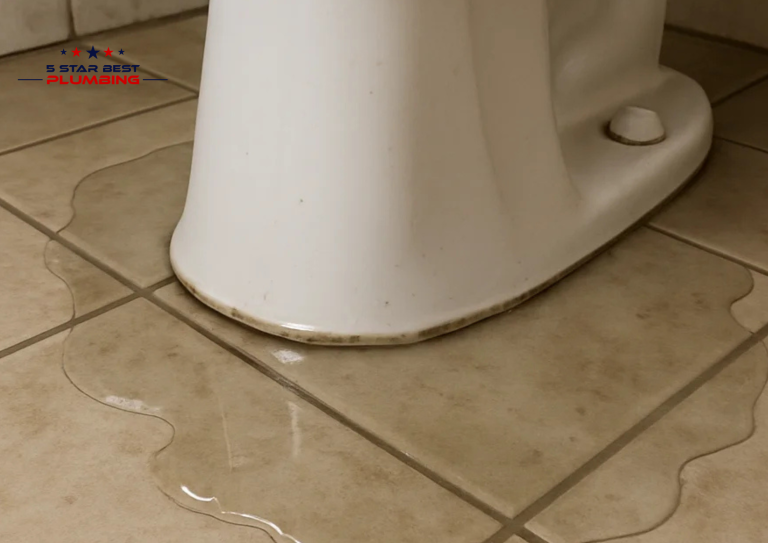
- You notice water on the floor around the toilet
- Your toilet runs constantly without properly shutting off
- Multiple toilets in your home are filling slowly at the same time
- You’d simply rather have a professional handle it right the first time
FAQs
How long should a toilet take to fill?
Most toilets refill in one to three minutes. Anything longer than that is worth looking into.
Can a slow-filling toilet raise my water bill?
Yes. A faulty fill valve can cause water to run continuously into the tank or bowl, adding up on your bill over time without you noticing.
Is it safe to keep using a slow-filling toilet?
Usually, yes — but it’s a sign that something is worn or failing. The longer you wait, the more likely a small problem becomes a bigger one.
Does hard water cause toilets to fill slowly?
It can. Mineral deposits from hard water are one of the leading causes of fill valve problems. If you live in a hard water area, your fill valve may need more frequent maintenance.